Abstract The most common sources of trouble in injection system are:
Plugging of needles by dirty (biological) samples.
Irreproducible injection volumes
The most common signs of trouble in injection systems are:
Ghost peaks in (blank) chromatograms.
Non-reproducible peak area.
LevelBasic
Sample introduction process:
In nearly all HPLC systems the sample is introduced with the aid of a high pressure injection valve, in which the sample is transferred under atmospheric pressure from a syringe or small bottle into a sample loop. By switching the injection valve the sample content is introduced into the high pressure flow from the pump to the column.
The flow through the sample loop is a laminar one: the velocity is at its maximum in the centre and approaches zero near the wall of the capillary. The front of the sample band pushes the mobile phase present in the sample loop forward, and is diluted in the process.
The valve is  actuated either manually or automatically, electrically or pneumatically.
Autosamplers work on the same principle in that they also utilize a high pressure valve.
More details on injection can be found in the topic circle on LC instrumentation.
The loop can be filled in two ways, which show different precision and reproducibility:
- Complete filling. The loop is filled with a syringe or from a bottle with an excess amount of sample. To obtain the best result the loop has to be flushed with 2 ‑ 5 times the loop volume. Taking into account other instrument parameters (viz. flow, temperature, eluent composition) reproducibility can be obtained in peak areas of approx. 0.5% RSD, which is better than partial filling.
- Partial filling. The loop can be filled partially with sample when a specially calibrated syringe is used. The other part of the loop remains filled with mobile phase. In view of the flow profile inside the capillary and dilution of the sample, only 50 ‑ 70% of the loop volume can be filled without problems. If more sample is injected, the top of the flow profile can end up in the waste and the injected amount will not be the same as the amount brought into the column. The volumetric precision depends on the quality of the syringe. The reproducibility of the total system will be close to approx. 0.8% RSD.
The subsequent injection of samples which strongly vary in concentration makes it essential to rinse the valve with eluent, especially at high detection sensitivities. A small quantity of sample can easily remain in the valve and interfere with subsequent runs and will cause "memory effects" which show up in blank chromatogram as ghost peaks at the same  retention times as these peaks in the previous injected samples.
In manual injections it is important to leave the injection syringe in the fill port opening during rotation of the valve for injection. This prevents a possible withdrawing of part of the sample from the loaded sample loop:
Taking out the syringe may suck sample back in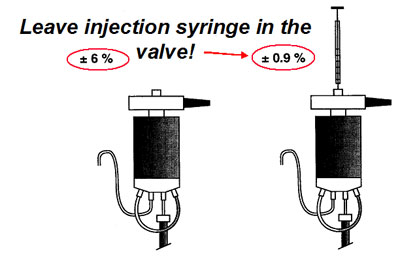
The connections between the capillaries and the valve are identical to those used for column fittings. Types of nuts and ferrules used, fitting techniques, precautions and problems etc., are the same as those discussed in column fittings. Leakages can easily be detected and corrected here. Be sure not to over‑tighten nuts and ferrules, and do not mix fittings from different manufacturers.
Left chromatogram shows tailing, caused by bad connection of sample loop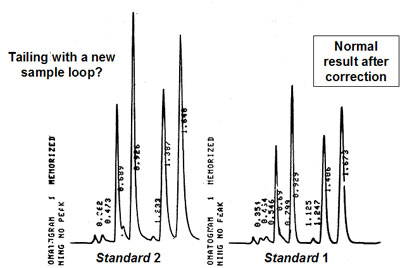
Scratches
Internal leakages from port to port may be due to scratches in the interior of the SS housing or on the polymer seal of the valve. If liquid is dripping out of the "waste" in the "inject" position of the valve there may be leakages from port to port. This can be observed if the waste tubing is transparent. Such leakages will result in badly reproducible injections. In such cases it is best to replace the valve.
Solid particles
In general it is sufficient to filter the eluent before and after the pump to avoid problems due to solid particles in the mobile phase. However, the sample itself may contain suspended solids and it is useful to prefilter or centrifuge the sample. A disposable filter  can be used for this purpose together with disposable syringes. This is an efficient and rapid way of filtering samples.
Clogging of the valve, caused by dirt or particles in the valve or sample loop, will show itself as high pressures or even  complete blockage of the mobile phase flow though the valve.
Often in "reversed phase" chromatography methanol‑water or acetonitrile‑water mixtures are used as mobile phases and it is common practice to dissolve the sample in the pure organic component, because of the poor solubility of the sample. This can cause problems when a fairly high percentage of aqueous buffer is present in the eluent. Injection made with pure methanol or acetonitrile can make the buffer precipitate inside the valve or on top of the column, which causes blockages and can damage the valve.
From a chromatographic point of view it is better to dissolve the sample in the mobile phase or rather in a solvent composition which has a somewhat lower elution strength. The sample will then be concentrated in a more narrow injection band on top of the column.
One could dissolve the sample in pure methanol first and then dilute it with water until the ratio desired is obtained. Large volumes of sample with a solvent strongly different from the eluent can have a considerable influence on the equilibrium inside the column. The injection volume has to be limited in these cases. Some examples:
Left: sample is dissolved in eluens.
Right: sample is dissolved in methanol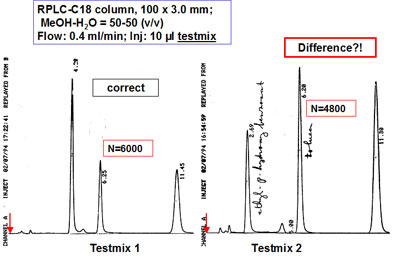
Dissolving in acetonitrile causes unacceptable peak broadening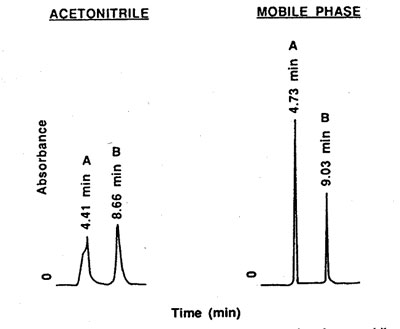
It is advisable to have a few spare parts of the valves used in the lab in stock. Almost any type of valve is equipped with a replaceable seal. To change this seal one has to know how to dissemble and clean the valve. While doing this, one may check at the same time the interior of the housing of the valve. It should be shiny and free of scratches, especially between the ports. When, after cleaning with acetone, dichloromethane, trichloromethane, etc. the scratches are still visible, the entire valve should be sent to the manufacturer for repair.
Many of the problems with autosamplers are more or less the same as described in the previous paragraphs. Summarizing these problems:
- Irreproducible sample volumes after repeated injections from the same standard
- Memory effects (carry over)
- Blockage of the syringe needle
- Insufficient flushing and cleaning between injections
When the autosampler has no mechanical defects but the precision and reproducibility seem to be deteriorating, the first check should be upon the autosampler (and not the other parts of the system). The autosampler can be checked by carrying out several repeated injections from the same standard.
- A common problem is blocking of the (double) needle with pieces of septa from the vials. Also the connection between the injection valve and its waste are often blocked.
- The content of the sample vial is often pressed into the needle and valve by compressed air. The pressure applied has to be regulated carefully in such a way that the "loop" is filled with an excess amount of sample. Deviations can occur when samples are used which have a different solvent viscosity. In such a case the air pressure and time of sampling have to be adjusted.
Better extraction, but bad chromatogram (bottom)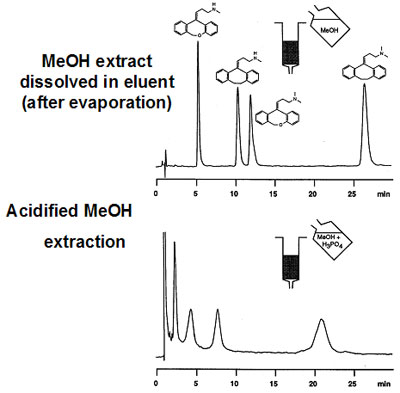
Extraction of the sample with methanol and injection result in a normal chromatogram. Extraction with acified methanol will result in a very acidic sample extract. Injection of this sample in the column will result in a "heavy" disturbance of the mobile-stationary phase equilibrium in the top of the column. Retentions and peakshape is completely different than under standard conditions.
Ghost peaks caused by contamination by septum/vial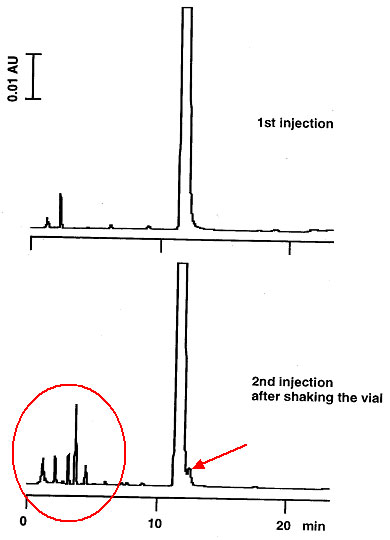
Impurities from sample vials (caps and/or septa!) can enter the liquid sample during storage of samples in the autosampler tray. Contact of the vial cap with the sample solvent may result in ghostpeaks in the chromatograms. Changeing the sample preparation procedure may be necessary, sometimes in combination with a different supplier for the vials.