Abstract Universal detectors detect any compound via the bulk properties of its solution, while specific detectors respond to physical or chemical properties of the sample compound. The detector’s limits (Limit of detection, limit of identification and limit of quantitation) are a function of both detector sensitivity and detector noise, and are defined as the quantities of analyte that generate a signal that is a given factor higher than the standard deviation of the blank signal (i.e. the noise). Other figures of merit, including detector dead volume and linear dynamic range should be considered in choosing a detector.
KeywordsDetector, Universal detector, Specific detector, Analyte, noise level (ND), Detector response factor (R), Linear dynamic range (DL), Instrumental sensitivity (S), Instrumental peak broadening (sd), Noise, Spikes, Wander, Drift, Filter, Limit of detection (LOD), Limit of identification (LOI), Limit of quantitation (LOQ), Time constant, Peak broadening
LevelBasic
HPLC detectors can be divided into two categories:
 Universal. The bulk properties of the liquid mixture (e.g. refractive index or dielectric constant) are measured. A UV detector is considered nearly universal.
- Specific. In this case, a physical or chemical property of one or more sample components is measured under ideal conditions. Fluorescence detectors are considered specific.
For more information on specific detectors, see the fluorescence detection article.
Universal detection methods are based on:
- Refractive index (RI detector)
- Conductivity (ionic compounds)
- Viscosity
- Light scattering
Universal detectors generate a signal for any compound which elutes from the column in the mobile phase. Since such a detector should work for any type of analyte, it would seem to be the first choice. In practice however, the analysis is often focused on a few target compounds and the remaining matrix peaks are not of interest. In fact, they can make the separation very complicated and interfere with the detection of the compounds of interest. In this case a sensitive and selective detector is preferred, which only generates a signal for the components of interest.
In addition to selectivity (specificity) or universality, general considerations such as overall sensitivity, stability and robustness are also important factors in selecting a detector. More quantifiable measurements of detector performance include:
- noise level (ND)
- detector response factor (R)
- linear dynamic range (DL)
- instrumental sensitivity (S)
- instrumental peak broadening (sd)
Note that some of these quantities are properties of the detector (instrumental peak broadening), while others are specific to the detection of a particular analyte (response factor).
Noise
Baseline disturbances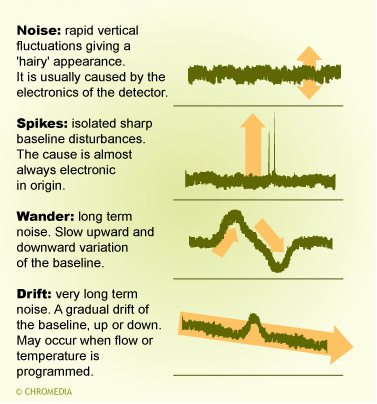
 Noise is often characterized by its frequency, which is the inverse of the noise feature's width in a signal trace. Noise is classified as:
Short-term noise (spikes): The frequency is considerably higher than the frequency of the eluting peaks, and thus, the spikes are much narrower than eluent peaks. This noise usually originates in the detector and amplifier electronics. It can be reduced by a proper noise filter which can be activated by the software.
Long-term noise (wander): The frequency is in the same range as the eluting peaks, so the noise peaks and the eluent peaks have a similar width. This noise causes problems for the correct detection of components near the detection limits. It results from, among other things, detector instability, air in the system, irregular flow, and sensitivity to ambient conditions (e.g. laboratory temperature).
Very long term noise (drift): The frequency is much lower than that of the eluted peaks. The baseline can rise or fall. Drift only causes problems in the detection of extremely small quantities of a compound. It can be the result of a slow change in the mobile phase, equilibration of the column, or a change in the temperature. Drift is to be expected when gradient elution is used. It is also possible that equilibrium has not yet been reached after changing the eluent composition in the column, causing a gradual drift of the baseline.
Detector response factor (R)
Response is the change in signal upon elution of a component. To determine the response factor, the detector response is divided by some indication of the amount of compound, either the total mass or the concentration. The response factor varies from compound to compound. Thus, chromatographic peaks from two different compounds may never be compared quantitatively without knowing the compounds' respective response factors.
Linear dynamic range
The linear dynamic range (DL) is defined, on the low end, by the limit of detection, LOD, defined below. The upper end of the linear dynamic range is the point at which the signal ceases to be directly proportional to the injected quantity of the component. Linear dynamic range is unique to a specific compound and instrument.
Dynamic range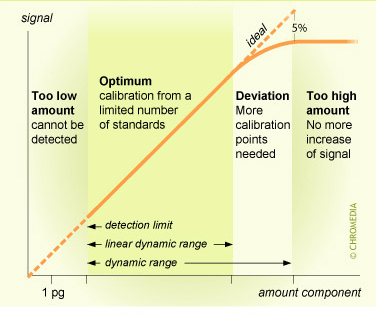
Typically, the upper limit of the DL is defined as the first point deviating by more than 5% from linear response. The linear dynamic range is a very important consideration in choosing a detector for a quantitative method.
Detector limits
The term sensitivity is often used interchangeably (and incorrectly) with other figures of merit, such as Limit of Detection or Limit of Quantitation. The detector sensitivity is the signal output per unit concentration or unit mass of a sample component in the mobile phase entering the detector. The sensitivity reflects the change in the signal amplitude at a given change in the response eliciting parameter (concentration or mass-flow). A detector's ability to provide useful chromatographic information depends on both the detector sensitivity and the noise. The lower limits of the detector's range are  described by the following quantities:
The limit of detection (LOD) in chromatography is equal to the concentration that produces a signal equal to three times the standard deviation of the blank signal. Below this concentration, the signal cannot be distinguished from noise. We must make clear that in practice several figures are used: two times the noise, three times the noise ....Limits of detection are subject to interpretation. The IUPAC and other organisations have set standards. The IUPAC text is: The minimum single result which, with a stated probability, can be distinguished from a suitable blank value. The limit defines the point at which the analysis becomes possible and this may be different from the lower limit of the determinable analytical range. We also refer to the Topic on Measuring & Validation by Leo de Galan
The limit of identification (LOI) is the smallest amount of an injected compound which can be identified within a certain accuracy level. Identification is normally based on the retention time of the component. The LOI can be defined as 6x the noise.
The limit of quantitation (LOQ) is the smallest amount of a compound which can be quantitatively measured (by peak area or height) with a defined accuracy. The LOQ is typically taken to be 10x the standard deviation of the blank signal.
The instrumental sensitivity (and noise) is dependent on a number of parameters. Take the example of a UV absorption detector, where signal can be a function of wavelength and the solvent. Thus, a UV absorption chromatogram should include an indication of both of these factors.
Instrumental peak broadening
As stated before, the entire system volume downstream of the injector valve contributes to peak broadening. This includes the detector. In general, a peak broadening of 5 to 10% is considered acceptable for the detector, including the tubing between column and detector cell. Thus, the detector cell must be selected to match column dimensions. The geometry (in addition to the volume) of the detector cell is also important, and much effort has gone into designing cells whose flow profiles minimize peak broadening.
Many detectors allow the user to manipulate the response time, as indicated by the time constant (t, msec). A long time constant allows the system to smooth out short term fluctuations in the signal, removing noise from the signal. Narrow peaks, however, may be smeared out into the baseline as well. This is of particular concern early in the chromatogram where the peaks tend to be much narrower.
The raw data of chromatograms is stored digitally on an integrator or computer. The detector typically relies on an analog transducer, so the voltage from the detector is first digitized with an Analog Digital Converter (ADC).
The use of computers enhances the accuracy of the analyses. Nowadays, the complete HPLC system is controlled by the software in a dedicated computer. After each run or series of runs, the data handling (integration, calibration and calculation) takes place automatically. In short, the entire control of a complete HPLC system is handled by the system software. A well designed system is capable of performing analyses 24 hours a day, 7 days a week.
