Abstract UV and visible absorption detectors are used to detect compounds that contain double bonds that absorb at appropriate wavelengths. Typically, a “monochromatic” band of wavelengths is passed through a cell, and the fraction of light transmitted (T) is measured and converted to an absorption (A = -logT). Variable wavelength UV absorption detectors can scan to take spectra, which provide additional information about components. Diode array detectors measure absorption at all wavelengths in parallel and can provide continuous spectra of the eluting components. UV detection is limited to absorbing samples and to methods whose eluents do not absorb themselves.
KeywordsAbsorption, Ultraviolet, Double bond, Beer’s Law, Transmittance, Absorbance, Extinction coefficient, Bandwidth, Wavelength, Filter, Monochromator, Diode array, Mercury lamp, Deuterium lamp, Tungsten lamp, Grating, Spectrum, Buffer
LevelBasic
Many analytes absorb UV-light, typically in the 200-300 nm range. The UV detector is therefore popular since it can detect compounds that contain conjugated or isolated double bonds, i.e. compounds with free or conjugated electron pairs. Some 'UV'-detectors offer both UV and visible light sources. The principle is the same regardless of the wavelength of light used:
UV Absorption detector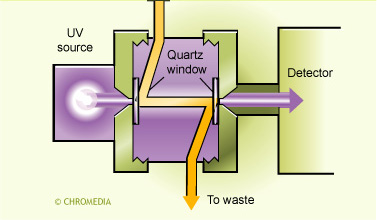
A light beam with a known wavelength (λ) and intensity (I) is transmitted through a sample cell. The intensity of the transmitted light (Is) is compared to the intensity transmitted by an empty reference cell (Ir).
As long as the two intensities are the same, no signal is generated. If an absorbing solute is present in the sample cell, the reference intensity and the sample intensity are no longer equal and a signal is generated. The ratio of the measured intensities Is/Ir, is called transmittance (T). The logarithm of 1/T is called the absorbance, (A = -logT), and is linearly proportional to the concentration of the solute in the eluent.
According to  Beer's Law, the absorbance (A) depends on the concentration of the compound (c), the pathlength of the cell (b), and on the molar extinction coefficient (ε) of the analyte:
A = εbc (Beer's law)
Obviously, the wavelength of the light and pathlength of the cell must be kept constant during the measurement in order to produce meaningful data.
Most compounds show the best absorbance in the UV-region (200 - 300 nm). When choosing the eluent, it is important to make sure that the eluent itself does not absorb light at the selected detection wavelength. In other words we must make sure that absorption is caused mainly or exclusively by sample components. Otherwise the detected absorbance signal caused by the analyte will become too low, resulting in a lower sensitivity.
Fixed wavelength detectors are the simplest and therefore less costly compared to variable wavelength detectors. The fixed wavelength must match with the peaks of the analyte's absorption spectrum. Fixed wavelength detectors typically employ a low-pressure mercury lamp or a gas discharge lamp as light source. Mercury lamps emit high light intensities at a few specific wavelength bands, while gas discharge lamps radiate more continuous emission spectra.
The wavelength range for the analysis (around 254 nm is common) is set with an interference filter. Such filters have a specific band width which is only transparent for a limited range of the source's spectrum. If we want to change the detection wavelength, we need to a change the filter. The bandwidth of the filter should be much smaller than the spectral width of the analyte's absorption peak.
UV-detector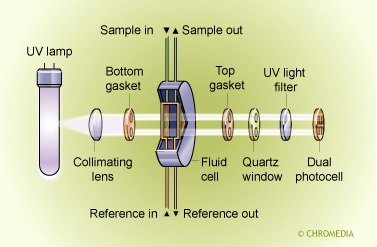
Fixed wavelength detectors generally include a single light source and relatively simple optics to focus a part of the light beam on the sample photocell and another part on the reference photocell. The transmitted signals are fed to a logarithmic amplifier (-log Is/Ir). The reference cell in modern detectors can remain empty (air reference).
In a variable wavelength detector, we can cover the entire spectral range with two different light sources: a deuterium lamp for the UV-range (200-400 nm) and a tungsten lamp for the visible range (400-800 nm).
Variable wavelength UV-detector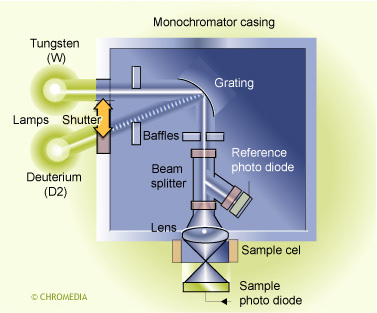
A monochromator (optical grating and slit) is employed as an adjustable filter to select the optimal wavelength for the analysis. One needs to select a narrow band of wavelengths somewhere in the range between 200 and 800 nm which shows good absorbance for the analytes. Wavelength adjustment can be done manually or by the software of the system. These detectors usually employ an autozero option.
Some variable wavelength detectors also include the option of measuring the component's absorption spectrum over a certain range. A full spectrum can provide additional information to the chromatographic retention values, and it may help to identify a component peak. The grating is rotated to scan the wavelengths of light through the cell as the system monitors the absorption and obtain a full spectrum of an eluting compound.
Before the Diode Array Detectors became popular (DAD's can 'see' the complete bandwidth and make a spectrum in an instant), the system would stop the pump while the grating scanned across the bandwidth of interest, recording a spectrum, after which the pump would resume. The dual lamps (and power supplies), the optical grating and the generally complicated optics make these detectors considerably more expensive than fixed wavelength detectors.
Diode-array detectors (DAD) consist of a set of diodes that continuously register the signal at specified positions - and at selected diodes - over a preset wavelength range. Array detectors have the advantage of detecting the individual wavelengths in parallel, at the same time. Each diode in the array measures the intensity of light over a small range (usually 5 nm) of the wavelengths exiting the cell. Time, signal and the wavelength are registered continuously, generating large amounts of data. Notice that while variable wavelength detectors place the monochromator before the sample cell, array detectors do not disperse the light into component wavelengths until after the sample cell.
Diode Array Detector UV After some signal processing, the measured signals from all the individual diodes are assembled into a UV-spectrum. Spectra can be calculated at any time during the analysis - each time point in the chromatogram has its own spectrum. Modern optics and electronics and a powerful computer are needed in order to handle the enormous amount of data generated by this type of (UV)-detector.
Before analysing samples the spectra of pure standards dissolved in the mobile phase may be measured and stored in the database of the detector. Comparison of standard and unknown retention times and spectra can improve the confidence of chromatographic identifications. Furthermore, because the ratio of the absorbance at any two points in a compound's spectrum is independent of the concentration, a DAD detector can also be used as a simple indication of peak purity. If the peak contains a single compound, the ratio of the signals should be constant (flat-topped) across the peak. If an interfering peak is present, the ratio will change as the second peak's spectrum superimposes itself on the first.
With the pH we can control the selectivity of the mobile phase which is important in order to effect complete separation of all peaks of interest, therefore we use buffers.
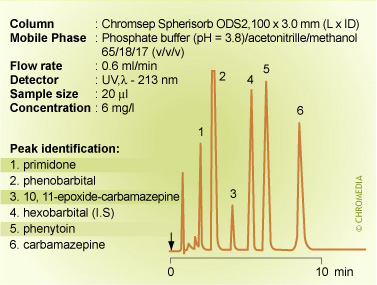
Low wavelengths are popular in UV analysis, since they provide sensitive detection of organic acids. At wavelengths below 220 nm however, organic buffers are unsuitable as the buffer itself would adsorb all the UV light in the detector cell. Below 220 nm we must use buffers e.g. phosphate, which is transparent over the entire UV region (as in the example below).
. Detection of barbiturates with UV at low wavelength