Multidimensional LC methods allow efficient analysis of complex samples and offer higher separation power than conventional LC. If a mass spectrometer is used as detector, the efficient separation also minimises problems with ion suppression.
This Topic currently covers the instrumentation required for the multidimensional LC and the parameters for on-line coupling. We are preparing a number of chapters e.g. applications in food and environmental analysis. Your input is welcome.
Abstract Many samples contain such a large amount of compounds that a single chromatographic separation does not provide sufficient separation efficiency. In such cases the separation power can be enhanced by using a multidimensional chromatographic technique. 2-dimensional LC can be divided into two categories, namely in heart-cut (LC-LC) and comprehensive techniques(LCxLC).
LevelBasic
A two dimensional separation is called 'heart-cut' (LC-LC) if only a few fractions of the first separation are transferred to the second separation.
Comprehensive two-dimensional liquid chromatography (LC× LC) is a form of liquid chromatography in which the entire sample is subjected to two different separations, to yield a contour map or colour map that is representative of the entire sample.
A method is considered multidimensional if the separation mechanisms in different dimensions are different and if analytes that are separated in one dimension remain separated in the other dimensions, i.e. if two peaks are separated in the first column, they will remain separated in the second column.
LC-LC.
The heart-cut techniques are applied if only a small portion of the components (from selected peaks) is selected from a complex matrix.
Heart-cut mode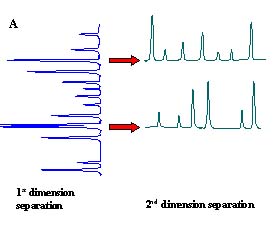 A typical example of heart-cut LC (LC-LC) is the analysis of drugs in biological sample (e.g. urine) and the 1st column is used mainly for selective clean-up and concentration. LC-LC is perhaps the most widely used multidimensional chromatographic method. The main applications of LC-LC are analyte purification and enrichment, and improvement of separation efficiency and sensitivity of the analysis.
LCxLC.
In the comprehensive techniques, the whole sample is separated in all separation dimensions, in this example in two dimensions:Comprehensive mode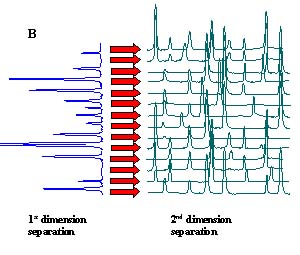
A two-dimensional separation can be called 'comprehensive' (LCxLC) if:
- Every part of the sample is subjected to two different separations
- Equal percentages (either 100% or lower) of all sample components pass
through both columns and eventually reach the detector - The separation (resolution) obtained in the first dimension is essentially maintained.
Comprehensive two-dimensional liquid chromatographic techniques (LCxLC) are used, when we need information from all sample components. An example of this type is the screening of metabolics in urine.